
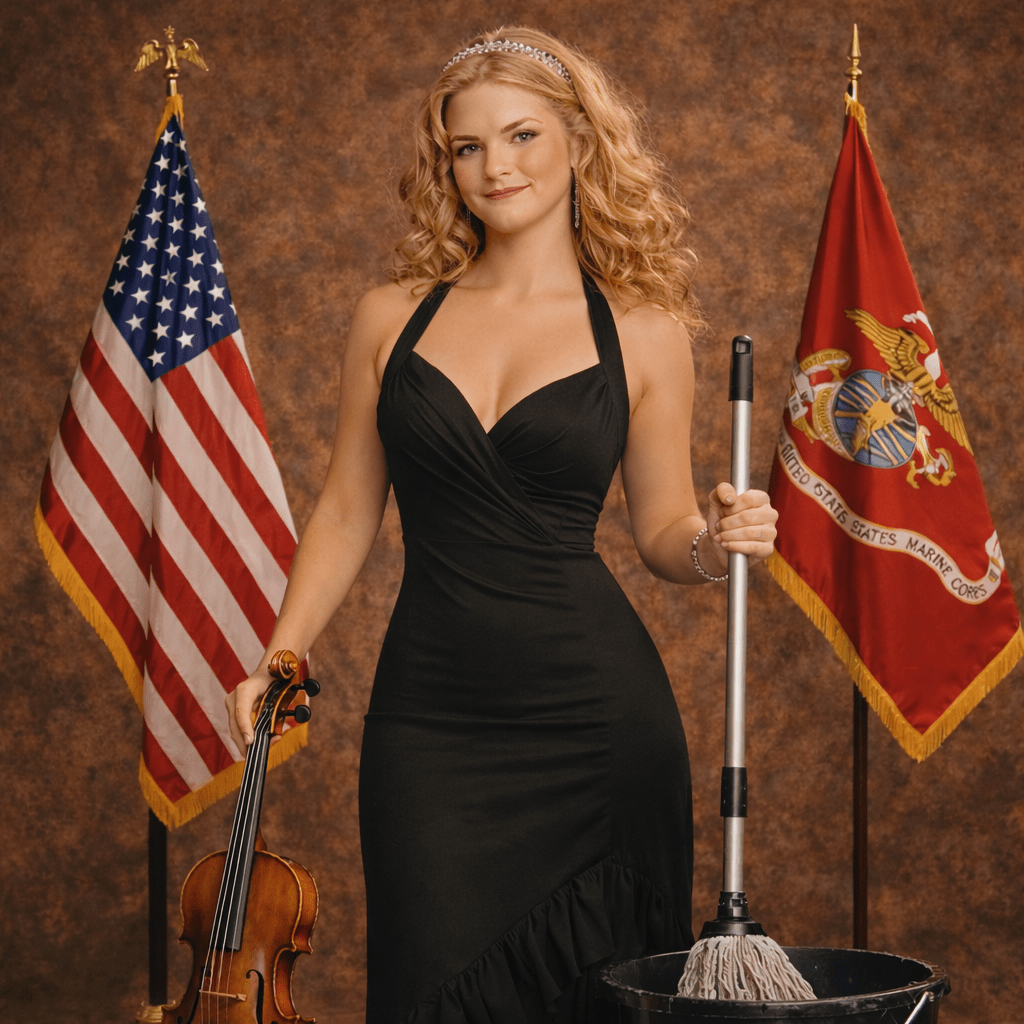
Big Fish, Small Pond, Wrong Door
By the time I was 18, I was fairly certain the world was waiting for me to arrive with a violin and improve it.
This confidence was not entirely imaginary. I was a very accomplished young violinist and knew it. I was concert mistress of our orchestra and third chair All-State by my senior year. I had scholarship offers from Florida State, Florida Southern, and Stetson. In Lakeland, Florida, I was not just good. I was known. And when you are 18 and talented in a town where people know your name, it is very easy to confuse local acclaim with global inevitability.
Then the Marines called.
Like most high school seniors back then, I had taken the ASVAB. I scored exceedingly well, which prompted the local recruiting office to ask whether I was interested in “being all I could be.” I told them no, because I was going to be a concert violinist and already had the scholarships to prove it. They countered by telling me I could audition for the Marine Band in Washington, D.C.
Not just any band. The Marine Band. The one that played for the President of the United States. The one so prestigious it made every other music opportunity sound like background entertainment at a Sizzler.
So, mostly to get them off my back, I submitted an audition tape.
Then I forgot about it.
Months later, after I had graduated high school and started college, I received a registered letter from the United States government informing me that out of 2,500 applicants, I had been selected as one of fifteen finalists invited to Washington to audition for one spot with the Marine Orchestra.
One spot.
Naturally, I handled this news with the humility and quiet grace for which 18-year-old girls are widely known.
I told everybody.
My mother got the local Ledger to run a story on my upcoming adventure. Since my family was well known in local social circles, I even received endorsements from U.S. Senator Lawton Chiles and State Representative Beverly Burnsed, which did not exactly calm me down. By then, I was no longer merely hopeful. I was mentally redecorating an apartment in Washington and preparing to casually mention, for the rest of my life, that I had once played for presidents.
In my head, I had already won. I was going to skip boot camp, be inducted as an E-5, travel the world, and become the kind of person who says things like, “When we were in Brussels…” without irony.
Outwardly, I was modest.
Internally, I was a full-blown legend.
My fiancé Sean and I drove to Washington in his gas-guzzling 1975 Monte Carlo, a vehicle roughly the size of a municipal building. It floated down the highway with all the precision of a drunken pontoon boat. We stayed in a Quaker boarding house with no air conditioning and a sign that read, “No fornication allowed on the premises.”
Nothing says romance quite like religious oversight and two twin beds placed far enough apart to prevent both sin and enthusiasm.
The audition was held at the Marine Barracks at Eighth and I, which is exactly as formal and intimidating as it sounds. I wore my black performance dress. At the beginning of the day, it said gifted young musician. By the end of the day, it said widowed by reality.
I strode into the green room carrying every ounce of confidence Lakeland had loaned me.
Then I heard the other violinists.
They were older. Serious. Polished. Focused. Nervous, yes, but in the controlled, purposeful way of people who actually belonged there. Most were in their late twenties or older. I was the baby by a mile, which is not ideal when you are trying to project world-class authority in a black dress and the emotional maturity of someone who had been told she was special just a little too often.
And they were all playing excerpts from the Tchaikovsky Violin Concerto.
Now, to be clear, I had chosen Fritz Kreisler’s Praeludium and Allegro, which is a difficult, technical piece. This was not me showing up with “Twinkle, Twinkle, Little Star” and a can-do attitude. But when you walk into a room full of adults casually peeling off Tchaikovsky like they were slicing lunch meat, your carefully prepared Kreisler begins to feel like an ambitious 4-H project.
That was the moment my confidence did not so much crack as explode quietly inward.
I realized, with breathtaking speed, that I had been a very large fish in a very small pond, and somebody had just dumped me into the Atlantic with no warning and inadequate emotional flotation.
They took us in groups of five. After each group, a major would come out and announce they had not yet chosen anyone and would continue listening. The first group went in and came out. Then the second. By then, my soul had left my body, hired separate transportation, and was halfway back to Florida.
Finally, it was my turn.
I walked into the audition room and found a long row of tables with twelve people seated behind them in full military dress, flags everywhere, all staring directly at me. The room had enough authority in it to make a lesser person confess to crimes she had not even committed.
There I stood: one girl, one violin, one bow, and one face so red it could have guided aircraft.
I introduced myself and began to play.
Badly.
Not artistically vulnerable. Not interpretively bold. Badly.
I thought perhaps my nerves would settle once I got moving. They did not. They escalated. By the time I reached the Allegro, I knew I was not recovering this. I was not even containing it. I was failing in real time, note by note, in front of twelve men in dress blues and enough flags to invade a small country.
So I stopped.
Mid-piece.
I looked at the panel and said, as calmly as I could manage, “Gentlemen, thank you for the opportunity to audition. I can’t tell you how much this means to me. However, I am not going to embarrass myself and you any further.”
Then I gathered my music, turned with what I hoped was dignity, walked toward what I believed was the exit, opened the nearest door, and stepped directly into a broom closet.
Not near one.
Into one.
I had apparently mistaken janitorial storage for freedom.
The door closed behind me. Almost immediately I heard knocking.
“Miss Jones? Miss Jones? That’s not the exit.”
At this point, I was fully committed to the bit.
I said, “I know. I’ll come out when I’m ready.”
Turns out I could embarrass myself further. I just had to apply myself.
So there I stood in a broom closet at the Marine Barracks in Washington, D.C., in my black performance dress, clutching a violin and what remained of my self-esteem, hiding among mops and cleaning supplies like a failed Cold War asset with no extraction plan.
I stayed in there a good long while. Possibly thirty minutes. Possibly several years. Time behaves differently when you are standing in a utility closet trying not to become a cautionary tale.
Eventually I came out, found the hallway empty, gathered up my violin case and my shame, and went outside.
Sean was sitting in the Monte Carlo listening to Steely Dan’s “My Old School,” doing his absolute best not to look at me. That, right there, is love. Not roses. Not sonnets. Not jewelry. Love is a man pretending not to notice when your life plan has burst into flames inside a federal building.
He finally cracked a joke and said he hated the traffic in Washington anyway.
I got into the car and informed him that we needed to find another place to stay, because I fully intended to drown my sorrows in alcohol and the Quakers seemed unlikely to endorse my healing process.
At the time, 18 was the legal drinking age in Florida, and in one of the few examples of strategic planning I demonstrated that entire trip, we had brought liquor with us just in case. Washington, as it turns out, is a city of drunks, Quakers, and secrets, and a Black Russian felt exactly like the right drink after a failed military audition in the nation’s capital.
So yes, I went to the bar in my mourning dress.
There I sat, still dressed for greatness, now drinking for closure.
And somewhere between the first sip and the complete collapse of my imagined future, I began to understand what had actually happened.
I had not just bombed an audition.
I had seen my place in the wider world.
That was the day I learned the difference between being exceptional in Lakeland, Florida, and being elite on a national stage. It was the day I realized that the brutal performance world required a set of nerves I simply did not possess. I played for a little while longer, but not much. Eventually I gave up the scholarships and built a career in management instead.
Turns out I am a far better manager than I ever was a violinist.
That truth came with more relief than grief, although I did not recognize it right away. At 18, it felt like humiliation. It felt like failure. It felt like I had publicly discovered, in formalwear, that my destiny had less to do with standing center stage and more to do with competence.
And honestly, competence has been very good to me.
The irony is that they chose no one. Not me. Not the Tchaikovsky crowd. Not even the man who had reportedly quit as concertmaster of a very famous orchestra because he was so sure he had this in the bag.
Nobody got the spot.
That softened the blow, but only a little. The real damage had already been done by self-awareness.
Still, if I could speak to that 18-year-old girl in the black dress, I would tell her to take that road trip, take that chance on herself, and not change a thing.
I would tell her that the day she walked into a broom closet in Washington was not the day her life fell apart. It was the day it quietly began to make more sense.
I would tell her that being humbled is not the same thing as being ruined.
And I would tell her what took me years to understand:
Failure is an event, not a person.
You can bomb an audition, hide with the mops, flee in a mourning dress, and still go on to build a life that fits you better than the one you had already started narrating for the newspaper.
In fact, sometimes that is exactly how it starts.


Leave a comment