My stepdaughter recently expressed a passing interest in possibly acquiring a new furry animal, as teenagers sometimes do when they are overcome by the romance of something soft, adorable, and completely dependent on someone else for survival.
Her father shut it down immediately.
“No more daily care animals.”
Now, I heard this and translated it the only way a reasonable woman would. Once our current household menagerie of one bunny, two dogs, and three cats crosses the rainbow bridge, future pets will apparently be limited to scales, shells, exoskeletons, and anything that can be emotionally fulfilled by a heat lamp.
Honestly, I am fine with that.
I have nothing against furry creatures. I love them. I just also understand that every adorable animal eventually comes with food, water, vet bills, emergency carpet cleaning, and the faint but persistent suspicion that something in the house has either died or expressed itself.
But the phrase stuck with me.
Daily care animal.
It sounds so simple. Some creatures require daily care. They need to be fed. Watered. Checked on. Let out. Brought in. Noticed. Protected from their own terrible decision-making.
And somewhere between cancer, surgery, divorce, work, hurricanes, loss, bills, survival, and the occasional toilet flapper crapping out, I began to wonder if I had somehow stopped being one.
I am very blessed now to be in a relationship with a man who is not threatened by my drive, my ingenuity, or my occasional tendency to solve problems with the calm determination of a woman preparing to testify before Congress. Jim does not wilt when I know things. He does not sulk when I fix things. He does not need me to shrink so he can feel tall.
That matters.
Because over the years, I have learned to become fiercely independent. Not in the cute, inspirational coffee mug way. I mean independent in the “I have already checked the exits, packed the backup charger, diagnosed the structural weakness, and identified three alternate routes before you finished asking if I brought snacks” way.
I became a survivalist out of necessity.
I became good at solving problems because life kept handing me problems, and the calvary, both literal and metaphorical, was rarely coming.
Let me illustrate.
During Hurricane Milton in 2024, I was living alone in Tampa in a first-floor apartment that backed up to a beautiful stretch of the Hillsborough River. Because of the slope of the land, my screened patio sat about twelve feet above the ground, close enough to the water that I could have tossed a pebble from my balcony and hit the river.
Oddly enough, the river was not what worried me.
The front door was.
Every decent afternoon thunderstorm sent water pushing into the shared entryway of my building. I had reported it to management more than once. Their solution was a French drain, which clogged with debris and somehow managed to make the problem worse, which is a special kind of engineering achievement.
The entry door had no latch. No lock. Just a pull handle and a dream.
Four apartments shared that entryway. Two downstairs, two upstairs. I was one of the downstairs units. It was not exactly the best neighborhood I had ever lived in, but it was what I could afford while going through cancer treatment and short-term disability. Everyone mostly kept to themselves, not out of rudeness so much as self-preservation. There are places where neighbors wave. There are other places where everyone silently agrees not to make eye contact unless something is actively on fire.
Enter Milton.
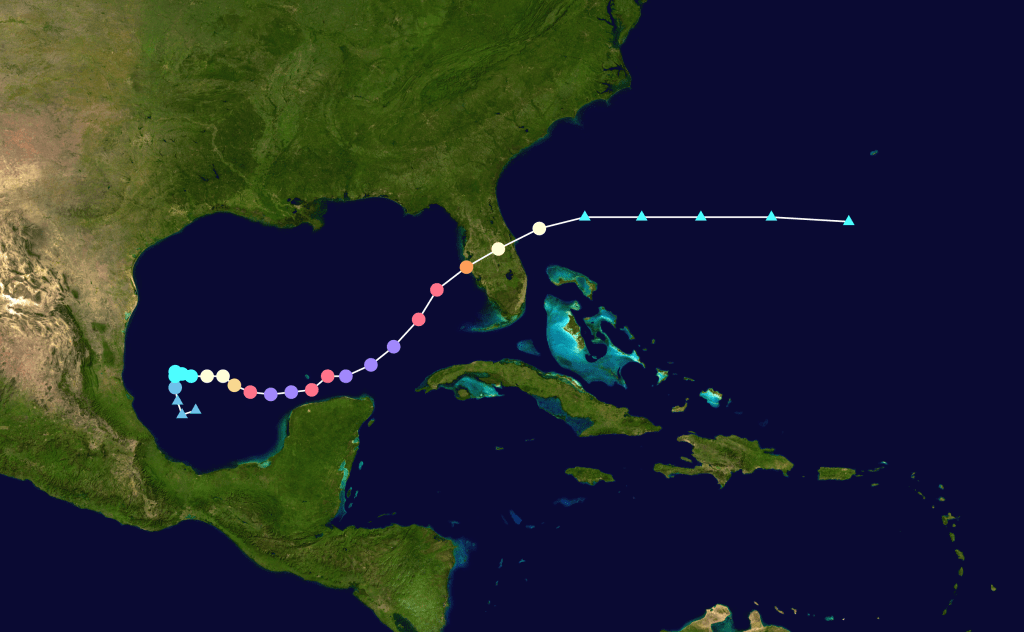
The threat was real for our area. Milton made landfall south of us near Siesta Key, but Tampa Bay was still in for a very long night. We were on the ugly side of that storm, and the right-side winds were brutal. That is the side of a hurricane where the wind does not simply blow. It arrives with a personal grievance.
And I knew my building was not going to flood from the picturesque river out back.
It was going to flood from the stupid, unsecured front door nobody wanted to fix.
I pleaded with management to install a latch. A lock. A clasp. A hook. A bungee cord. Anything that suggested civilization had reached this particular doorway. It just flopped flaccidly on its hinges like the dashed dreams of my ex-husbands.
Nothing.
So I did what life has apparently trained me to do.
I went to AutoZone.
There are women who cope with stress by lighting candles and journaling. I cope by buying ratchet straps and developing a structural mitigation plan.
By that afternoon, I had my survival plan in motion. I had battery-powered lanterns, battery-powered fans, a high-end cooler, snacks and food I would actually eat, and my little Anker power bank charged and ready. I had learned a few things from Hurricane Irma, most notably that emergency food is useless if it is the kind of food you would only eat after losing a bet.
I should probably mention that Jim had invited me to stay with him well inland.
I demurred.
Not because I did not want to be safe. Not because I did not appreciate the offer. But because my meager belongings were in that apartment, and I knew exactly where the failure point was. I could see the problem. I could fix the problem. And leaving before I fixed it felt like abandoning the only small kingdom I had.
So I stayed.
That afternoon, I knocked on every door in my building to make sure no one planned to leave. The man next door was not especially thrilled to be awakened by a wild-eyed woman announcing that the building was going to flood, but I noticed later he had installed a foam threshold protector, so apparently I had achieved at least partial credibility.
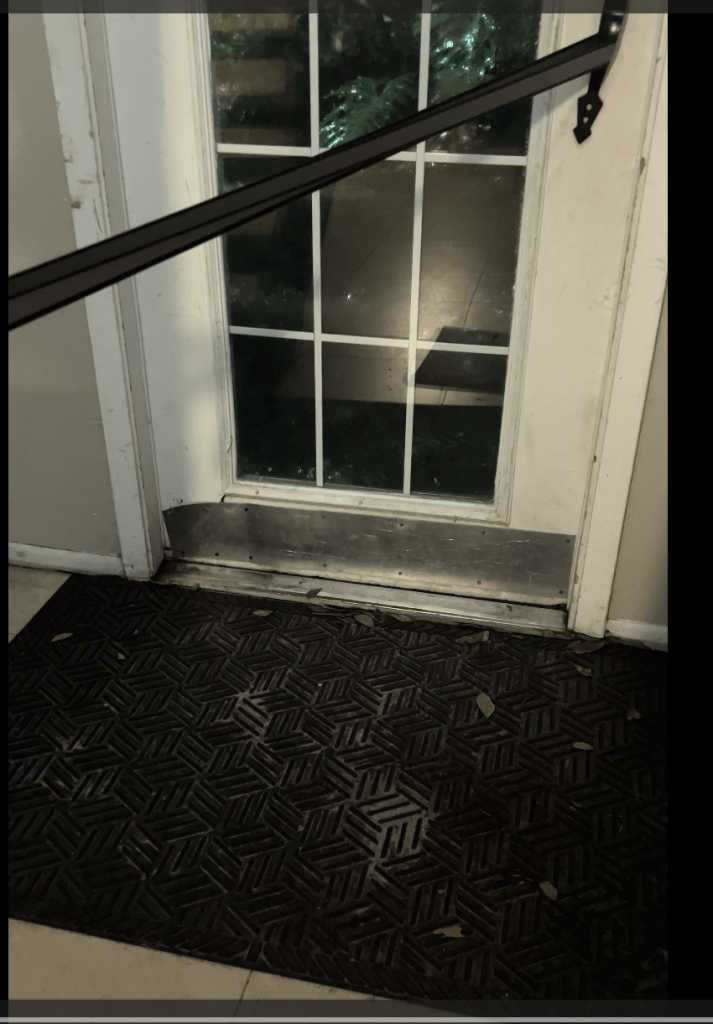
I taped a note to the inside glass with my phone number, in case any emergency personnel was needed. Only God Himself was going to be able to breach that door without my assistance. Then I ran the ratchet strap through the interior door handle and secured it to the stair bannister. I tightened that thing until the door, which had never sealed properly in its life, was suddenly clamped shut like it owed me money.
Then I waited.
Milton was supposed to come in at night, because apparently hurricanes prefer drama lighting. By late afternoon, the sky had that strange, sickly look Florida gets when something large and unreasonable is approaching from the Gulf.
The power went out around 8pm.
No worries. I had lanterns.
The stark glow of fluorescent bulbs in the face of my candles cast an eerie little apocalyptic light across the apartment while I tried to entertain myself with my tablet, only to discover I had forgotten to download movies. This is how you learn the difference between prepared and almost prepared.
My dog, Coco, was with me through all of it.
She was not an emotional support animal in any official, paperwork-bearing sense. She was just my dog. Which is to say, she was my witness, my shadow, my tiny heartbeat with fur, and the only creature in that apartment who thought my disaster planning was completely reasonable as long as snacks remained available.
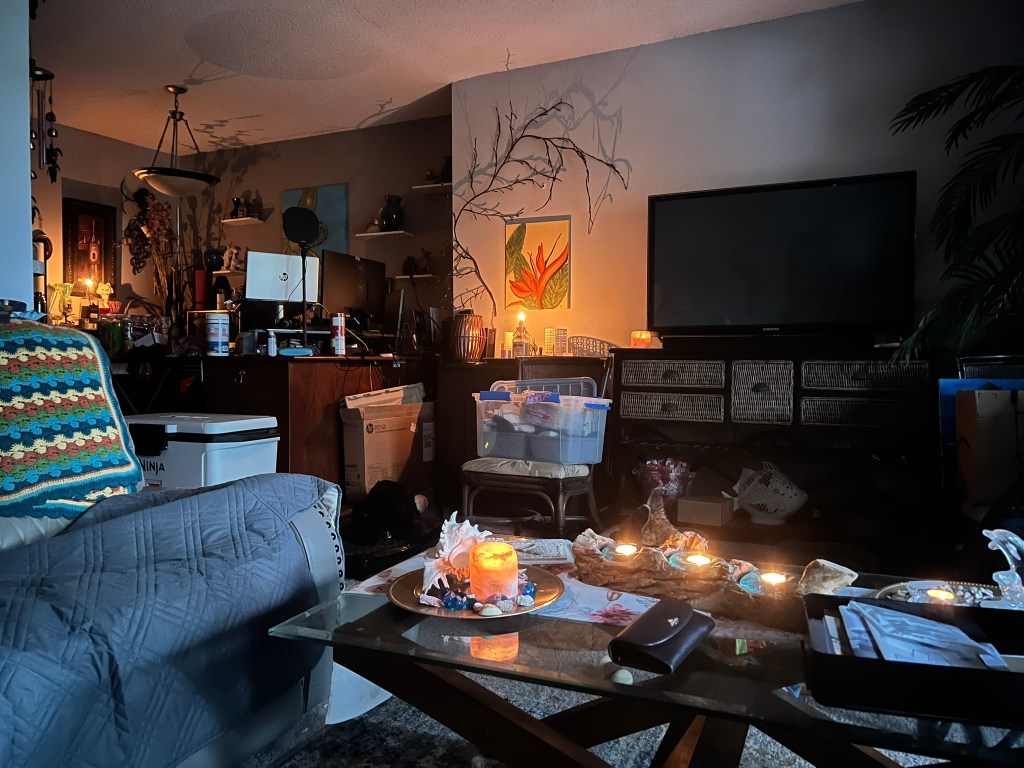
In the dark, with the wind clawing at the building and the rain slamming sideways against the glass, Coco became the warm, breathing reminder that I was not entirely alone. I may have been the woman with the ratchet straps, lanterns, power bank, and flood mitigation strategy, but she was the reason the room still felt like a home instead of a bunker.
Undeterred, I plugged my refrigerator into my cute little Anker power bank, and two hours later, the damn thing was dead.
Outside, the wind picked up, and all hell broke loose.
I made my way back to the front entry door, which had large glass panes, and through flashes of lightning I could see the water piling up against it. Not trickling. Not puddling. Piling.
The water reached around fourteen inches deep outside that door.
And not one drop came inside.
My ridiculous ratchet-strap system held.
I checked it all through the night, partly because I was proud of it and partly because I am not the kind of woman who trusts a single solution until I have monitored it like a patient in ICU. Believe me when I say, I did not sleep a wink that night.
The next morning, the water had receded. Behind me, the river had never breached its bank. The flood threat had happened exactly where I said it would.
When I released the strap and stepped outside, the complex looked like a war zone. Huge debris was everywhere. Doors from adjacent apartment buildings had been ripped off their hinges. Entryways were obliterated. We later learned a small tornado had torn through the apartment complex during the storm, because apparently a hurricane alone lacked sufficient flair.
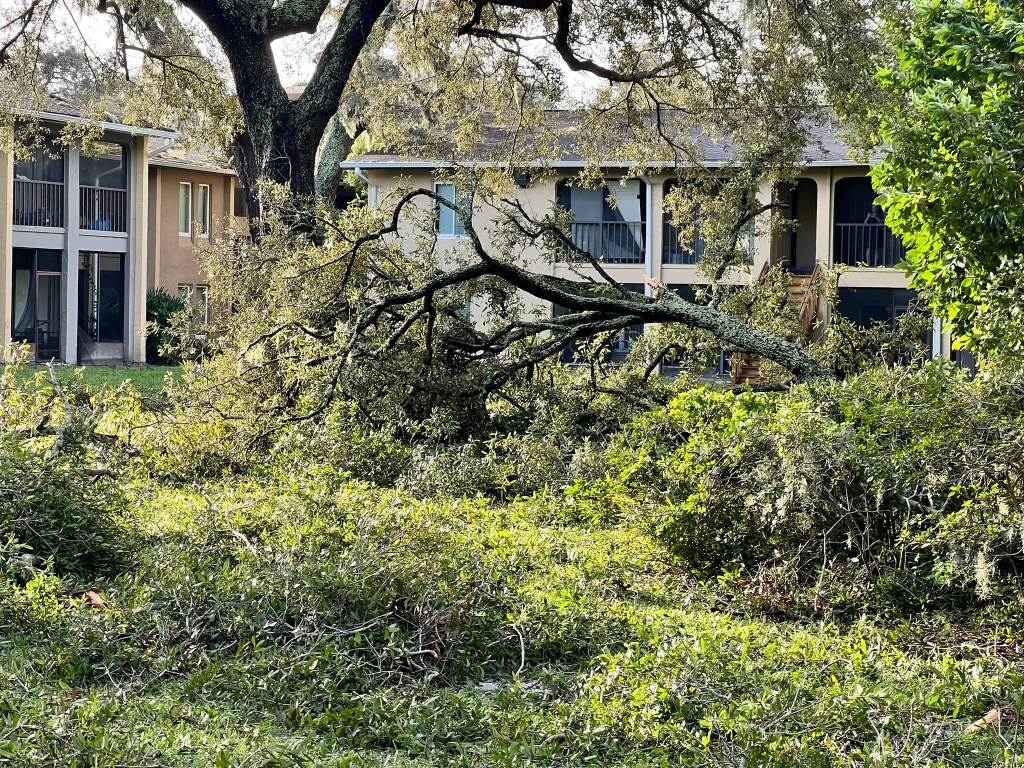
But our little fortress was untouched.
We were safe.
I would love to say that was the end of the story, but the aftermath was worse. Way worse.
I had no power for seven days.
The apartment was ungodly hot. I slept badly. At night, the darkness felt heavy. Sirens wailed. News reports said looting had started in nearby areas, and I sat there locked down in my apartment, sweating like a sinner in church, combat-shopping online for a bigger power supply system before the next storm could even form off the coast of Africa.
Interesting side note: I did own a propane gas camp stove.
Not because I was some rugged backwoods survivalist. No. I had bought it because at some point I had apparently entertained the idea that, easing into my sixties, I might take up tent camping again.
What the hell was I thinking?
There are lies we tell ourselves, and then there is the belief that a woman with a history of major abdominal surgery, insomnia, and strong opinions about mattress quality should voluntarily sleep on the ground for recreation.
Still, there it was. My little propane camp stove, purchased during a brief delusion of outdoor enthusiasm, suddenly became useful.
I also had a portable electric Ninja Woodfire grill for patio cooking, because apparently my emergency planning had range. A small handful of people in the complex had generators. Others had coolers, grills, extension cords, frozen meat, melting ice, and a deep collective desire not to let hundreds of dollars’ worth of groceries rot in the Florida heat.
So the neighborhood, where people had barely spoken to each other before the storm, became a small disaster kitchen. We used whatever cooking equipment was available. Propane stoves. Electric grills. Gas grills. Generators. Coolers. Folding chairs. Questionable extension cord configurations. The whole thing had the energy of a church picnic organized by FEMA and supervised by feral cats.
People cooked community food before it spoiled. We shared what we had. We checked on each other. It was one of those strange, lovely moments when catastrophe strips away the nonsense and reminds everyone that civilization is mostly just people deciding not to be awful for a few hours.
I had also bought an EGO battery-powered blower a couple of months earlier to clear spider webs off the far side of my patio, because maintenance at that place was less a department and more a rumor.
What were the odds that a single woman in an apartment complex would ever need a leaf blower?
Pretty good, as it turned out.
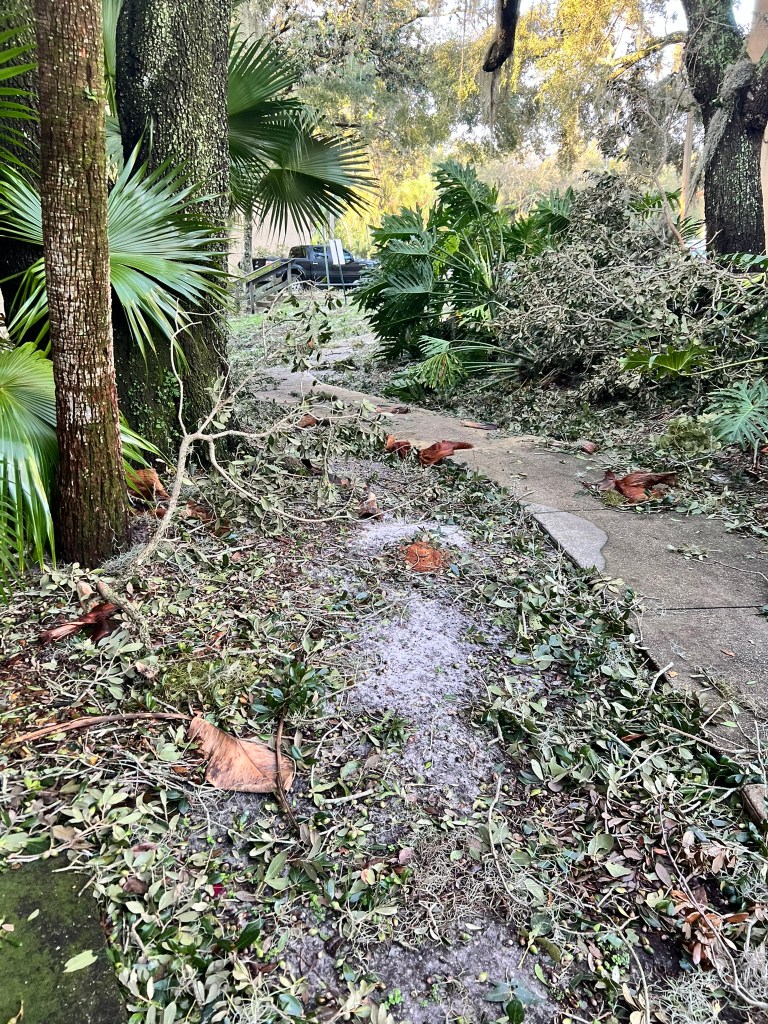
Armed with my blower, I helped clear debris from the paths between the buildings and the parking lot so people could walk without stumbling over branches. Because apparently even in a disaster, I am less “please help me” and more “stand back, I have equipment.”
Every day, I had to recharge my stressed out, woefully underpowered little Anker in my vehicle, which took approximately the same length of time as the construction of Stonehenge. I used it to recharge fans and my phone. I rationed battery life. I sweated. I listened. I planned.
And before the power was even restored, I had already gone and bought two much bigger Anker power stations with solar panels, thereby guaranteeing that I would never again be at the mercy of one tiny power bank and my own failure to download movies.
That experience showed me I could survive whatever life threw at me.
Unfortunately, it also reinforced the idea that I had to.
That is the tricky part about surviving things. People see the strength and admire it. They praise you for being resilient, independent, capable, resourceful. And all of that is true.
But survival mode does not always know when to turn itself off.
At some point, preparedness becomes more than a plan. It becomes a posture. A way of standing in the world. A belief system built around the idea that nobody is coming, nothing is guaranteed, and if you do not solve the problem, the problem will eat you alive.
That mindset saved me more than once.
It also exhausted me.
Because somewhere along the way, I stopped asking myself what I needed on ordinary days. Not storm days. Not surgery days. Not divorce days. Not scan-result days. Ordinary days.
Did I need rest? Did I need comfort? Did I need help?
Did I need someone to notice I was tired before I became a crisis with shoes on?
Apparently not.
Apparently, I had moved out of the daily care animal category altogether and become something else.
A cactus, perhaps. A moderately attractive succulent with Wi-Fi.
A low-maintenance woman with a hurricane kit, a battery-powered blower, and unresolved trust issues.
But here is what I am starting to understand.
I did not become low-maintenance. I became deferred maintenance.
There is a difference.
Low-maintenance means easygoing. Flexible. Not fussy. Able to roll with things.
Deferred maintenance means nobody has checked the oil in 40,000 miles, the warning light has been on since Easter, and everyone is pretending the noise under the hood is probably fine.
Women like me are often praised for not needing much. We are admired for pushing through, holding it together, solving the problem, making the call, finding the workaround, keeping the lights on, or at least locating enough battery power to keep the fan running.
And don’t get me wrong. I am proud of that woman.
She kept me alive. She protected what little I had.
She stood in front of a glass door during a hurricane and watched fourteen inches of water press against it while a ratchet strap from AutoZone held the line between disaster and dry carpet. She deserves respect.
But she also deserves care.
That is the part I am learning now.
Being independent does not mean I no longer need tenderness. Being capable does not mean I should always have to be. Being prepared does not mean I am at peace. And being able to survive alone does not mean loneliness is proof of strength.
Coco knew that before I did.
She did not care how prepared I was. She did not admire my ingenuity. She did not ask to see the emergency plan or applaud the ratchet strap engineering. She simply stayed near me, warm and steady, reminding me without saying a word that even survival feels different when something breathing loves you back.
Maybe that is why daily care animals matter.
Not because they need us.
Because they remind us that care is daily.
Not dramatic. Not heroic. Not reserved for emergencies.
Daily.
Food. Water. Rest. Attention. Affection. A soft place to land. Someone checking to make sure you have not wedged yourself behind the refrigerator of your own life.
I do not want to lose my independence. I earned it honestly. I built it out of necessity, grit, fear, stubbornness, AutoZone ratchet straps, and the deeply held belief that my knight in shining armor is probably not coming.
But I am starting to understand that independence is not the same as isolation.
Preparedness is not the same as peace.
And being able to survive without help does not mean help is an insult.
Maybe that is the next lesson.
Not how to weather the storm.I know how to do that.
Maybe the next lesson is how to let myself be cared for on ordinary days, before the sky turns green, the lights go out, and I start measuring floodwater through the glass.
Maybe I am still a daily care animal.Maybe I always was.
I just became very good at hiding the care instructions.


Leave a comment